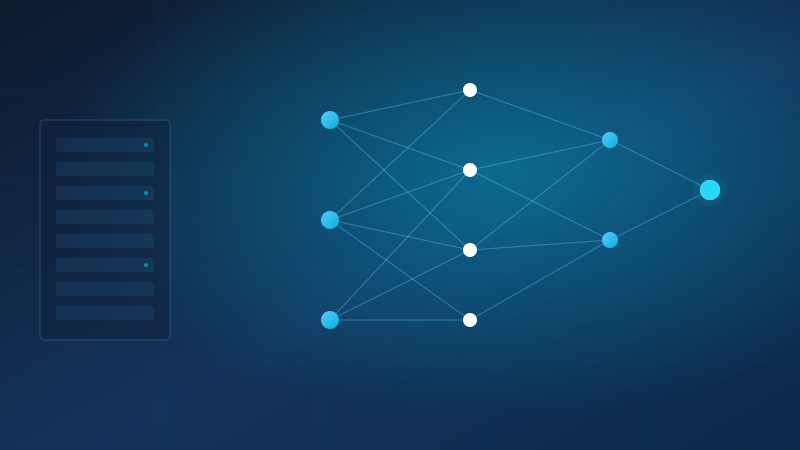
The first generation of hyperscale data centers was built around a relatively forgiving design assumption: workloads were diverse, power densities were moderate, and facilities could be designed once and operated largely unchanged for a decade or more. That assumption no longer holds for a growing share of new development. A distinct facility type — the AI factory — is emerging, with its own design logic, economics, and risk profile.
What Actually Distinguishes an AI Factory
An AI factory is not simply a cloud data center with more GPUs. It is a facility designed from first principles around the requirements of large-scale model training and, increasingly, high-throughput inference: extreme power density per rack, liquid cooling as a baseline rather than an option, network fabrics optimised for GPU-to-GPU communication rather than general-purpose traffic, and power architecture sized for highly correlated, often volatile load patterns across thousands of accelerators operating in close synchrony.
The IEA's satellite-based tracking of facilities purpose-built for AI shows this category has more than tripled in capacity over the past eighteen months — a pace of build-out that is itself evidence these are not simply upgraded versions of existing cloud campuses, but a new construction category entirely.
Design Implications Across the Facility
The shift from cloud campus to AI factory touches nearly every system in the building:
- Power: Rack densities that once topped out around 10–15 kW now routinely reach 120–140 kW for current-generation GPU clusters, with next-generation platforms expected to exceed 200 kW
- Cooling: Air cooling, effective to roughly 15–40 kW per rack depending on configuration, gives way to direct-to-chip liquid cooling and, in some deployments, immersion systems
- Structure: Floor loading, equipment weight, and piping infrastructure require structural assumptions closer to industrial facilities than conventional commercial buildings
- Networking: East-west bandwidth between accelerators becomes as critical as north-south connectivity to the outside world
The Economics Are Different Too
AI factories typically involve higher capital cost per square foot but also higher revenue or utilisation density per square foot for tenants running GPU-intensive workloads. This changes how facilities should be evaluated financially — metrics like cost per kilowatt of critical IT load and time-to-energisation often matter more than traditional cost-per-square-foot benchmarks inherited from general-purpose data center development.
An AI factory is not a cloud campus with more cooling capacity bolted on — it is a different building, designed around a different physics problem.
Tenant Demand Is Driving the Distinction as Much as Technology
It is worth noting that the AI factory model is not purely a technology-driven phenomenon — it is equally a response to how AI-focused tenants evaluate facilities. A hyperscaler or frontier AI developer negotiating for a large training cluster is evaluating fundamentally different criteria than a traditional cloud or enterprise tenant: guaranteed power delivery dates, contracted density commitments, and increasingly, some assurance that the facility's electrical and cooling architecture can scale alongside the tenant's own hardware roadmap over the lease term. Facilities that cannot speak credibly to these criteria are simply not competitive for this segment of demand, regardless of their conventional cloud-era credentials.
This has pushed developers to engage with prospective AI factory tenants much earlier in the design process than was typical for general-purpose hyperscale facilities — sometimes before a site is even fully secured — to ensure that electrical, cooling, and networking specifications are aligned with what large AI compute tenants actually require, rather than designing speculatively and hoping demand will fit.
Capital Markets Are Beginning to Price the Distinction
As the AI factory category matures, capital markets are increasingly distinguishing between it and conventional hyperscale assets in how they price risk and return. AI factory assets, with their concentrated tenant exposure and higher technical complexity, can carry a different risk profile than diversified colocation or cloud campuses — sometimes compensated by longer lease terms and stronger contractual commitments from well-capitalised AI infrastructure tenants. Investors evaluating this category increasingly need underwriting frameworks that explicitly separate AI factory risk and return characteristics from those of the broader hyperscale data center market, rather than treating the two as a single undifferentiated asset class.
Not Every Facility Needs to Be an AI Factory
It would be a mistake to conclude that all future data center development should follow the AI factory model. General-purpose cloud, enterprise, and lower-density colocation demand remains substantial, and over-rotating an entire portfolio toward extreme-density design introduces its own risks — particularly given uncertainty about how quickly inference workloads may favour smaller, more distributed facilities over centralised training clusters. The more durable strategy is portfolio and campus design that can accommodate both models, with modular expansion paths that do not require the entire site to be over-built on day one.
DATAPERT works with developers and investors to determine which sites and programmes warrant true AI factory design, and which are better served by flexible, phased hyperscale architecture. Learn more about our approach to data center development and technology integration, or start a project with our team.